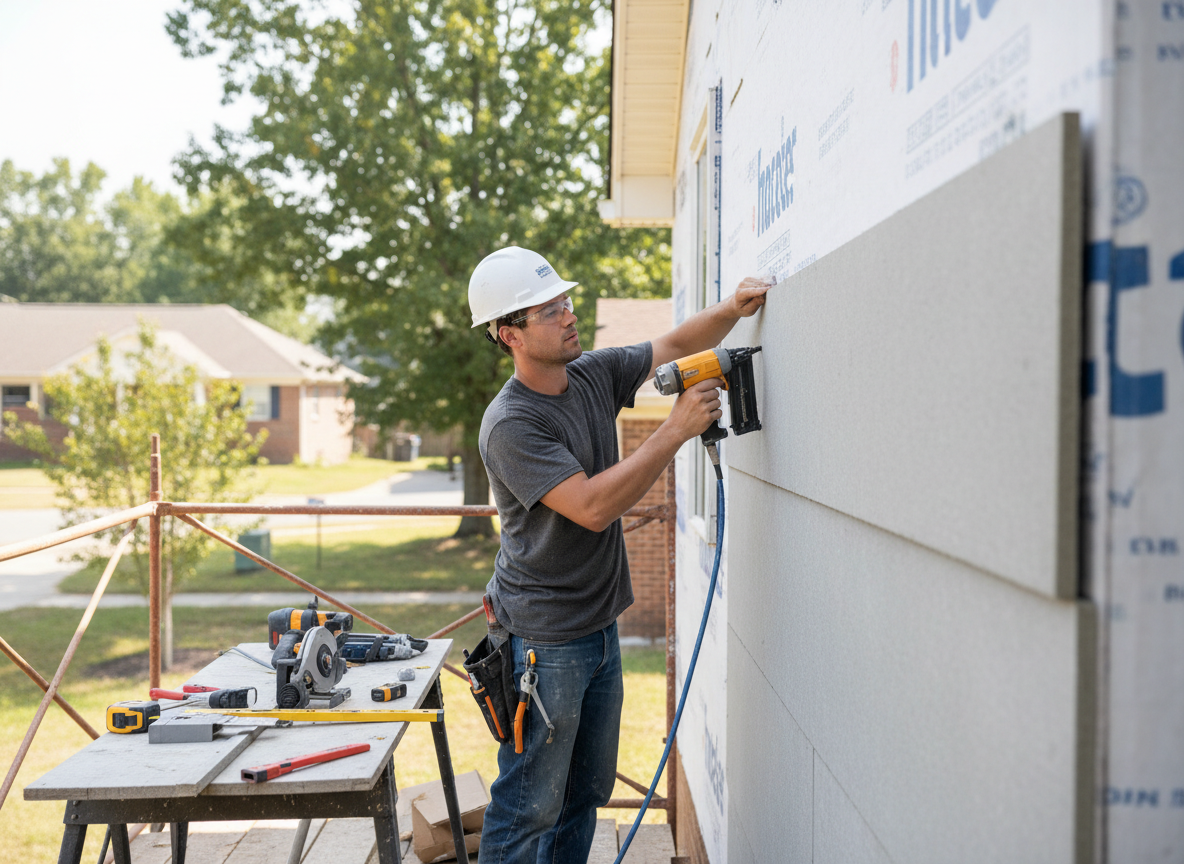
Concrete board siding, often called fiber cement, stands up well to the mixed weather patterns around Montgomery in Hamilton County. Older homes in neighborhoods like those near the Montgomery Square area frequently need full replacements because original wood siding has warped from repeated freeze-thaw cycles. Proper fastening to the sheathing and leaving the correct expansion gaps prevents cracking when temperatures swing sharply between winter lows and spring thaws.
Edge cases appear often on two-story homes with steep rooflines common in the Montgomery area. Installing around gable ends and window trim requires precise cutting so water cannot wick behind the boards. We always check for proper flashing at roof-wall intersections and around penetrations because missed details here lead to hidden moisture damage inside walls.
Local building practices in Montgomery call for specific nailing patterns and weather barriers that meet current residential codes. Skipping the right underlayment or using the wrong fasteners shortens the life of the siding when heavy spring rains hit. Homeowners should inspect the bottom course after each winter to catch any lifting before it allows water intrusion.
Installation Considerations
Homeowners in Montgomery often overlook how soil movement near older foundations affects the bottom edge of concrete board. We recommend a minimum clearance above grade and installing a metal starter strip to keep the material from wicking ground moisture. Checking for proper ventilation in the attic also reduces the risk of condensation behind the new siding during humid Ohio summers.
Technician insight
In Montgomery, the thing that catches most people out with concrete board siding is how older homes in the area have settled foundations that leave the bottom course too close to grade, letting winter moisture wick up and cause rot behind the new boards.
Concrete Board Siding on Settled Montgomery Home
The homeowner noticed buckling boards along the north wall after a wet spring. We found the original sheathing had softened near the foundation due to inadequate clearance. We replaced the damaged sections, raised the starter strip, and installed new concrete board with proper flashing. The siding now sheds water correctly and matches the rest of the house.
How it works
- 1
Site Assessment
We examine existing siding, sheathing condition, and moisture issues on the Montgomery property.
- 2
Material Selection
We match concrete board profiles and colors to the home while confirming proper thickness for local wind loads.
- 3
Preparation
Old siding is removed, damaged sheathing is replaced, and a new weather barrier is applied.
- 4
Installation
Boards are cut, fastened, and sealed following manufacturer guidelines for the Montgomery climate.
- 5
Final Inspection
We verify flashing, caulking, and trim details before cleanup and walkthrough with the homeowner.
Pricing
Upfront quotes provided after on-site assessment; final cost depends on home size, stories, and existing damage.